Showing posts with label gardening. Show all posts

Green and Growing: More Poems about Gardens and Gardening

The 2025 gardening season began for me in February when I pruned the raspberries and tayberries (oh, those wicked thorns!). I wasn't yet truly done with the 2024 season, in the sense that I still had berries and vegetables in the freezer waiting for me to turn them into something despite the complete canapalooza canathon canstravaganza I put up in jars in 2024.

I created a big garden bed full of poems I harvested along the way that same year. They just keep coming, the way the world keeps turning, the sun keeps rising, rain keeps falling, seeds keep doing their amazing thing and turning into plants that make more seeds. 

Now it's 2026 and I'm deep into another year of gardening. Heirloom seeds courtesy of my neighbor's generous daughter populate my raised beds. She shared her large stock and even started some plants for me: peppers, tomatoes, cucumbers, five varieties of basil (Genovese, sweet, mammoth, Thai, ruby). Volunteer potatoes showed up early, telling me I didn't get all of them dug last fall. I relocated plant after plant into one raised bed that's now filled with a mass of greenery, the soil beneath where I hilled up the plants completely hidden. The new garden beds I created around a couple of trees give me more space for flowers. One of them bloomed with bulbs that I planted last fall. Those green shoots of hope poking through the soil shouted "Spring!", then died back as a reminder that I need to do more if I want color throughout summer and fall.

"Happiness"
Paisley Rekdal

I have been taught never to brag but now
I cannot help it: I keep
a beautiful garden, all abundance,
indiscriminate, pulling itself
from the stubborn earth:

Maya Stein

There are outlines of what will unfold in the beds.
That first tiny, ripe tomato. 


Curled carcasses of leaves all over the paths, kale stiff and starchy,
the basil stalks skeletal. What if, she wonders, I do nothing? A whole season
could pass this way, every death taking its own putrefying time and she
on the other side of the window, warming her toes on the hearth.

Joy Sullivan

I waited so long for love
and suddenly, here it is
standing in the garden, hands full
of heirlooms hot from the sun.

"In the Garden"
Fabiana Fondevila

There’s zeal ripening in the tomatoes
and purpose in the pumpkin vine
trampling its way to freedom.

There is inner city grit in the hydrangea
struggling to bloom
in its chewed up dress and tortured feet.


It is important for me to be down on my knees,
my fingers sifting the black earth,
making those things grow which will grow.
Sometimes I save a weed if its leaves
are spread fern-like, hand-like,
or if it grows with a certain impertinence.

"In Time"
Rosemerry Wahtola Trommer

In soil not yet worked this spring,
two perfect rows of parsley emerge 
in a curly leafed celebration of green, 
vestiges from last year’s planting.


I’ve seen the neighbors frown when they look over the fence
And see our espalier pear trees bowing out of shape I did like that
They looked like candelabras against the wall but what’s the sense
In swooning over pruning I said as much to Mrs. Jones and I swear
She threw her cane at me and walked off down the street

"Making Sense - or I Pledge Allegiance" (scroll down on the page to find the poem)
Carrie Newcomer

I lift up my face to the summer sky
The sound of larks
And the feel of dirt
To all that keeps making sense
In senseless times.

Related Reading

Seed Snail 'Speriment: Episode 2

 Episode 2 will be short and sweet: Seedlings! Eight days by the calendar after the planting April 28, although that was an evening project so it's more like 7-1/2 days.

The morning of May 6 as I misted the coils I spotted three tender stems still bent over, tops buried.


By the end of the day the biggest of the three had lifted its leaves to the air.


By the next morning, May 7, those leaves stood taller, a second one had freed its top, and the first green bent-over stem appeared in the golden straightneck summer squash.


By the evening of May 7 that first golden summer squash had stuck its leaves up in the air although they're still a bit bent over, a second was visible, the Mortgage Lifter tomatoes had sent up a couple of tiny threadlike stems, and the Black Like Tula tomatoes had the tiniest hint of green at one spot. Time to capture this for posterity. This is happening!


I do need your reassurance that you also see the Tiny Tinerton Tomato seedlings here, if your eyes are that good.


Okay, okay, here's a close-up.

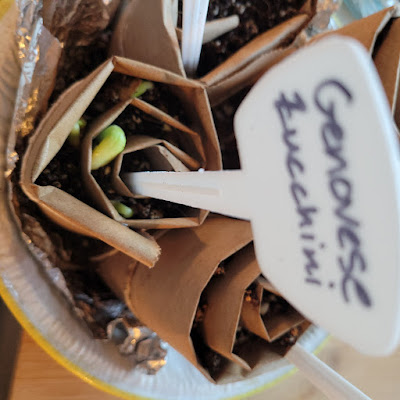
Photo from above of seedlings emerging from coils of brown paper holding potting soil. Two tiny, tiny little green threads, one holding two tiny leaves.

For real, I swear, there's a tiny spot of green coming up in the Black From Tula Tomato.


As exciting to watch as when I was a kid poking seeds straight into the dirt of the family garden!

Seed Snail 'Speriment: Episode 1

Kind of a gutsy move to name this Episode 1 given that I don't know whether I'll have any reason to write Episode 2, but here goes.

My acupuncturist and I were talking about gardening and she mentioned using "seed snails" as her technique to start plants from seed this year. She has a greenhouse, which makes her A Serious Gardener in my book. She said this technique gave her much stronger starts last year than the usual system of little individual soil pots.

I'd been thinking of starting seeds but couldn't figure out where I could possibly do so, with no real room in the garage to do a grow light set-up, almost nowhere in the house that Bad Cat can't get to that would have the kind of space I'd need for big seed flats. Rolls of seeds saving a lot of space and getting good results? This sounded as if it would be worth a try. 

At least it will be a leg up on my usual "poke them in the soil, hope the growing season is long enough for them to produce something" method which netted me only a couple of zucchini last year, and who can't grow zucchini?! Me, that's who. I've also been reading Vegetables Love Flowers and am a bit more attentive to soil temperatures than in the past (another reason not to poke everything into the soil just yet). 

A quick visit to Dr. Google and I had some how-to on the snail seed-starting method from Rural Sprout. I also had a DIY recipe for seed-starting mix, also from Rural Sprout. A trip to Eastside Urban gave me perlite and vermiculite that didn't have any extra unwanted ingredients.

The Rural Sprout post gave me most of the information you'll need if you want to try this. I'll add a couple of notes on things they didn't specify or that I did a little differently.

How much mix for how many rolls? The ratio is 2:1:1: coconut coir:perlite:vermiculite. I made a total of 2 quarts of mix. This turned out to be more than enough for the 10 rolls I made. I think I should have made the mix a little bit deeper so I'd probably make this amount again for the same number of rolls. I used the extra in one of my big planter pots where I was putting in a couple of lemon thyme plants.


Wet coir, or dry? If like me you buy it in compressed blocks, not shredded in a bag, the picture doesn't really tell you. I had to wet down the coir to get it to break apart, so that's what I went with.


Dampen the mix before making the rolls. This makes it a bit clumpier and easier to work with.


How much twine will you need? A length a bit longer than the length of my paper strip gave me enough to go around the roll twice and tie off.


What kind of paper/cover. I cut up a couple of brown paper sacks and ended up with 10 strips. The piece that had been the bottom of the sack was a bit tougher to roll up since it was stiffer but it worked.


Poking the seeds down into the mix: That's tricky in these skinny spaces. I used the end of the plastic stakes I was using to mark the varieties to poke the seeds down in. Could have used a chopstick or something similar, maybe a toothpick.


This isn't a completely scientific test of the process. I used seeds I had on hand that are at least a year old, some of them possibly older. Sweetie scored some packets of heirloom seeds at the community garden when he was dropping off some food to give away last year and they don't have dates on the packets. They're all heirloom varieties except for the jalapeños and those are from Ed Hume Seeds based in Puyallup, so they're pretty local.


What I planted:

  • Tomatoes: Cream Sausage, Black Sea Man, Black by Tula, Thorburn's Terra-Cotta, Mortgage Lifter
  • Peppers: Datil (hot! 100,000-300,000 Scoville heat units) and jalapeño.
  • Squashes: Golden Straightneck Summer Squash, Rheinau Gold Summer Squash, Genovese Zucchini 
  • Mystery Melon: I saved seeds from a really sweet Italian melon similar to a cantaloupe that I ate in the summer of 2022. I didn't write down the name of the variety, but at the time I looked up and found it was an heirloom variety and the seeds would be true if I saved them. I dried and saved them in such a good spot I forgot about them in 2023. In 2024 I planted some in a bucket, got small plants and one small melon that I didn't pick in time to eat it so it self-composted. Trying again!

I set the rolls up in a couple of pie pans in our big kitchen window. It faces north so it gets light without being too hot. Now to wait and see.

"Sweet Harvest"

A poem I wrote Sept. 28, 2024, after discovering my beds of raspberries included some canes that put out a second late autumn harvest I wasn't expecting.

"Sweet Harvest"Vintage watercolor illustration of red raspberries

All summer long I harvested
raspberries, ripe crimson jewels,
queen of the berries.

Now in autumn I am surprised
by a late crop on tall canes.
I gather a taste
of sweetest summer,
all the sweeter for coming late
when hope of sweetness had passed.
I pass the bushes one way, thinking
I have found all there is to gather.

Looking back I see that
what I thought was not yet ready
is ripe and beautiful
and asking me to pick.
Asking me to take the sweetness into me.


Hey Honey: Poems about Bees

The delightful novel "The Bees" by Laline Paull features bees and the life of a hive, anthropomorphized enough that you relate to their anxiety when they can't find blooms and their concern for healthy hatchlings. It feels true, in a way, with real behaviors of bees turned into plot elements in the life of Flora 717, a worker bee of unusual size and strength.

Both before and after reading it I encountered a variety of poems about these industrious producers of sticky sweetness. Sometimes they appear in passing, bumbling from flower to flower. Sometimes their activities and their sweet product serve as the entire focus. Since every bite of food we eat relies on these and other pollinators, they deserve a hive full of poetry.

Lo and behold, that hive already exists! I discovered If Bees Are Few: A Hive of Bee Poems thanks to American Life in Poetry mentioning it in the intro to the Naomi Shihab Nye and Linda Pastan poems linked here. That collection goes back 2,500 years, whereas my tastes run to contemporary poetry. If these poems give you a taste and leave you wanting more, maybe you want to track down a copy in the used book market.

I grew up in a house that had a couple of giant honey locust trees in the far corner of the property, past the big garden. One of them held the "Freehouse Treehouse" my brothers built for my younger sister and me, and I remember climbing up through the scented sweetness with bees buzzing all around. That made the first poem by Mary Oliver a must-include for this list. 

At the end of the collection I list some actions you can take to help bees. We rely on them (and other pollinators) for our entire food supply so it's in our best interest to care about the bees.

"Honey Locust"
Mary Oliver

The bees circle the tree and dive into it. They are crazy
with gratitude. They are working like farmers. They are as
happy as saints. 

"Honey"
Robert Morgan

....If you go near bees
every day they will know you.
And never jerk or turn so quick
you excite them.

"Playing with Bees"
RK Fauth

all the strong words in poems,
they were once

smeared on the mandible of a bee

"Appetite"
Paulann Peterson

Between your teeth
is the blown flower and the flower's
seed. 

"Honey"
Connie Wanek

Luxury itself, thick as a Persian carpet,
honey fills the jar
with the concentrated sweetness
of countless thefts,
the blossoms bereft, the hive destitute.

"As You Fall Awake"
Laura Ann Reed

as bees
thrust their passion
deep into the promise
of tiny crimson-purple
blooms.

"Instructions to the Worker Bee"
Lucy Adkins

It's not just about pollen or nectar,
the honey that eventually comes,
but the tingle of leg hair
against petal, against pistil and stamen,

"Robbing the Bees"
Carrie Green

But today the scent of orange blossom
reaches our patch of sand, and the beeyard
teems with thieving wings.

"Bees Were Better"
Naomi Shihab Nye

Bees had radar in their wings and brains
that humans could barely understand.
I wrote a paper proclaiming
their brilliance and superiority

"The Death of the Bee"
Linda Pastan

Soon the buzzing
plainchant of summer
will be silenced
for good; 

the flowers, unkindled
will blaze
one last time
and go out.

"April in the Ruins"
H.R. Kent

something is happening up at the pueblo—
bees are pouring out of the cave-roof bedrock
a thick smoke of thousands, shooting
the queen and prince of drones
higher and higher in a ball.

"The Water Carriers"
Angelo Giambra

On hot days we would see them
leaving the hive in swarms. June and I
would watch them weave their way
through the sugarberry trees toward the pond
where they would stop to take a drink,
then buzz their way back, plump and full of water,
to drop it on the backs of the fanning bees.

"Hum"
Mary Oliver

What is this dark hum among the roses?
The bees have gone simple, sipping,
that's all. What did you expect? Sophistication?
They're small creatures and they are
filling their bodies with sweetness, how could they not
moan in happiness? 

Five things you can do to help save the bees

  1. Create pollinator habitat. This can be as small as a pot of blooming flowers on an apartment balcony, as big as an entire yard turned over to naturescaping principles (landscaping for wildlife, birds, insects and water conservation). 
    • Check in with the County Extension office in your county if you're in the United States and they'll be able to provide information. Extension offices are part of the land grant university mission and are an amazing resource for many topics from gardening to nutrition to forestry and much, much more. 
    • Pollinator Partnership also has free ecoregion planting guides for habitat in the US and Canada. I'm in the Pacific Lowland Mixed Forest habitat.
  2. Buy local honey. While honeybees are a non-native European import (400 years ago), if you're going to eat honey anyway then local honey doesn't have to travel as far to get to your morning biscuits. 
  3. Eat organic food if you can afford to do so; pesticides and herbicides harm pollinators.
  4. Donate to nonprofits and universities doing research and supporting pollinators.
  5. Ask your city, county, and state departments of transportation, roads or public works to provide pollinator habitat when they choose plants. Public right-of-way makes up a big chunk of the town you live in. As they decide which trees to plant, where to put in shrubs and plants to help hold soil on a hillside, they can choose native plants and provide habitat. I work for a state DOT doing just that. Maybe your state already does this, maybe they need some encouragement.

Bee conservancy projects, nonprofits, and university research can all benefit from your donations. 

Keep It Growing: Poems about Gardening

We moved into our Olympia house four years ago in late November, too late to do anything about yard or garden. The first spring brought recognition that we were the proud owners of an awful lot of false dandelion, burdock, and a layer of clay, none of which was particularly conducive to the kind of vegetable gardening and naturescaping that I hoped to do.

That meant a year of gardening in pots (tomatoes and herbs) and using my Grampa's Weed Puller weekend after weekend. I plugged the holes with a bit of compost and clover seed, seeking to add some health to the soil and habitat for pollinators when it bloomed. On the side of the property that gets the best sunlight we began laying plans for gardening in raised beds. My sweetheart worked to level the ground for a terraced set-up that will eventually hold six beds. We put in two raised metal bins on another side of the property suitable for growing greens.

Fast forward and I have three of the planned six beds on that sunny side. The raspberries and tayberries we put in next to the house are thriving; the raspberries I didn't prune last fall even gifted me a second late crop of some big, beautiful jewels. The elderberry bush put on so many berries this year that unfortunately the sheer weight broke off a major branch, but the bush has already propagated a little neighboring bush. The nectaplum (a nectarine and plum hybrid), hazelnut, and almond trees are well established and will start producing sometime in the next few years. 


And the tomatoes in those beds! Whoa. Definitely should have planted them with big strong trellises to climb on. I had to muscle those much-needed trellises in late to get the vines up off the ground and somehow got away with it, but next year they'll be trained from the beginning.

As I start each morning with poetry, naturally I find poems that celebrate the earthy abundance of gardening. Before this year's harvest of vegetables and herbs ends, I'll share this harvest of poems.

"Believe This"
Richard Levine

....All morning,
muscling my will against that of the wild,
to claim a place in the bounty of earth,
seed, root, sun and rain, I offered my labor
as a kind of grace, 

"Tender"
Jose Antonio Rodriguez

But about the strength and will to cradle the plants
Outside—the pruning, the watering, the sheltering

In found tarps and twine against the coldest nights.
To lean into the day’s hard edge,

And still find that reserve of tenderness
For the bougainvillea, the hibiscus, the blue morning.

"Patriotism"
Ellie Schoenfeld

My country is this dirt
that gathers under my fingernails
when I am in the garden.
The quiet bacteria and fungi,
all the little insects and bugs
are my compatriots.

"Gardening as a Form of Worship"
Bruce Taylor

To bring us to our knees.
To bring us back to quiet.
Inclined as we are
to this labor and attention.

"Vegetable Love in Texas"
Carol Coffee Reposa

Farmers say
There are two things
Money can't buy:
Love and homegrown tomatoes.

"A Warm Summer in San Francisco"
Carolyn Miller 

Although I watched and waited for it every day,
somehow I missed it, the moment when everything reached
the peak of ripeness.

"Slower"
Rosemerry Wahtola Trommer

They are beautiful, the Japanese eggplant,
dangling beneath wide fringed leaves.

"Therapy from the Garden"
Glenn Morazzini

From the lettuce there is common sense for narcissism:
acceptance as side dish, garnish for a meaty sandwich.
If that leaf isn’t the dose, there’s always the soil
people shovel and level, rake and make wishful with seed,

"An Observation"
May Sarton

True gardeners cannot bear a glove
Between the sure touch and the tender root,
Must let their hands grow knotted as they move
With a rough sensitivity about
Under the earth, between the rock and shoot,
Never to bruise or wound the hidden fruit.

"The Seven of Pentacles"
Marge Piercy

as things grow in the real world, slowly enough.
If you tend them properly, if you mulch, if you water,
if you provide birds that eat insects a home and winter food,
if the sun shines and you pick off caterpillars,

"Towel and Basin"
Michael Escoubas

This morning I plodded in pajamas
and bare toes toting my full water pitcher,
prepared as an offering for my
hanging blue Fan plant. The tall
grass washed my feet as Jesus might.

"Practice" 
Rosemerry Wahtola Trommer

I plunge my hands into the soil
and tug on the long white bindweed roots
that cling to the cool damp dark.
Never once have I pulled the whole plant.
Always, the bindweed comes back.

"More"
James Crews

I know it’s summer when we wade out
into the field and pick these crisp wonders,
tiny cucumbers bleached of their green
as if they’ve already seen too much
of this dazzling light, and can take no more.

"Planting the Sand Cherry"
Ann Struthers

It is important for me to be down on my knees,
my fingers sifting the black earth,
making those things grow which will grow.

Rosemerry Wahtola Trommer

Each firm, red-skinned round
I pull from the earth is a small proof
of how things can grow in the dark—


Summer ends with a chill over the garden,
breath of coolness to make the spinach
and lettuce happy. I pick another bucket
of tomatoes, more chewed each harvest,
and welcome the wildlife to this messy table


Tomatoes, Tomatoes, Tomatoes!

Oh, so many tomatoes. Little Shop of Horrors in the raised beds. Too much temptation at the farmers' market in early spring with too many varieties. Eleven tomato plants later in early September, I'm picking a growing number of pounds. Every day.

Orange, red, and black cherry tomatoes. Red and yellow grape tomatoes. Heirloom yellow tomatoes. Black Prince (which is a little slower to come on but was an incredible producer for me last year). A fun pink and green striped "tie-dyed" tomato named Pink Berkeley, also slower to produce and one of those that grows a somewhat lobed, lumpy tomato that makes for funny slices. San Marzano and some other kind of Roma/paste tomato. 

At one point after I'd missed picking three days in a row due to workshops and a conference out of town I picked 14 pounds: a giant bowl of all the small ones, a big colander of the big ones.

Tomatoes, tomatoes, tomatoes.

Thanks to Food in Jars I knew not to double any recipes that involve cooking them to a jammy quality. Tomatoes take a long time to cook down, and the juicier they are the longer it takes. Since I have a lot of cherry tomatoes in my mix I have a lot of juice. The most I did was scale up by about a pound, adjusting other elements accordingly. 

I cook in my widest deep saucepan for maximum surface exposure to cook off the juice, or in a new Lodge Dutch oven I sprang for that's now possibly my favorite pot. Hot tomatoes really spit so even though it's tempting to crank up the heat for a fast boil I don't leave it at a full boil. I ramp it up (7 on my induction cooktop, which tops out at 9), then turn back to 6 or even 5.

Recipe #1: Smoky, Spicy, Skillet Tomato Jam by Food in Jars. I tend to hold back on the heat so I didn't put in as much as it called for in crushed red pepper and I substituted Aleppo pepper for the cayenne. Still very tasty.

Recipe #2: Tomato Jam by Serious Eats. The most popular recipe on her site, a sweet and savory version. Sort of ketchup-y in its flavor profile.

Recipe #3: Orange Tomato Jam with Smoked Paprika. To my disappointment (and that of other commenters) "orange" didn't mean a tomato/citrus jam. It meant jam made with orange tomatoes, which are lower in acid than red varieties so the recipe is adjusted accordingly. I had plenty of orange cherry, yellow grape, and yellow heirloom after about three days' picking so I made this. For the record, all tomatoes darken as they cook down so it's sort of a smoky dark orange.

Recipe #4: I wanted that citrus! So I mashed up a couple of recipes and went for spices that sounded good when I tasted them in my head. My sources:

Tomato Citrus Marmalade
  • Tomatoes: Around 4-1/2 lbs.
  • Oranges: 2, cut into eighths, seeds removed, and very thinly sliced, peel and all
  • Lemon: 1, cut into eighths, seeds removed, and very thinly sliced, peel and all
  • Sugar: 4 cups (too much!)*
  • Salt: 1 t.
  • Cinnamon: 1 t. to start; added 1/2 t. toward end
  • Ginger: 1 t. to start; added 1/2 t. toward end
  • Allspice: 3/4 t.
  • Coriander: 1/4 t. (could leave this out if you don't like the flavor)
  • Mace: 1/4 t. ( could use nutmeg too, or instead)
  • Aleppo pepper: Added 1/2 t. toward the end when I tasted

*This was too sweet! I wish I had started out with 2-1/2 or 3 cups of sugar instead of 4. When I tasted at the end after it had thickened up and concentrated the flavors, the citrus was strong but so was the sugar. I know it's needed for the set but not all the Food in Jars recipes use a sugar ratio that's this high.

So I adjusted. I added more cinnamon and ginger, and some Aleppo pepper for a smokeyish heat.

Still too sweet. I opened my spice drawer and stared it for inspiration. Sumac! That adds a sourish flavor and wouldn't be off-putting in this. I added 1 t. sumac and another 1/2 t. Aleppo. More salt is always a good idea; another 1 t.

Tasted again. I hadn't harmed anything, at least. Still kind of cloying. It really needed acid at this point but it had thickened so nicely I hated to thin it and back up. Added another 1 t. Aleppo pepper. It was pretty good by the end but still sweeter than I'd wanted. You could pour this on ice cream and no one would bat an eye.
Photo of small plastic bags holding tiny dried tomatoes, labeled Dried Cherry Tomatoes, Dried Orange Tomatoes, Dried Black Cherry Tomatoes, Dried Yellow Grape Tomatoes
Recipe #5: Dried Tiny Tomatoes from Food in Jars. This was the day I picked 14 pounds, tired after a full and intense week, and I wanted to move things along as quickly as possible. I kept the orange, red, and black cherry tomatoes and yellow grape tomatoes separate as I sliced and prepared the trays for my dehydrator. Very pretty!

Recipe #6: Slow Oven-Roasted Roma Tomatoes from Food in Jars. Yep, same "wow that's a lot of tomatoes" day.

Recipe #7: A cross between three recipes, with spice ranges provided because I used an initial quantity, then did a taste and adjust when it had cooked down pretty far. The inspirations:
  • Sungold Tomato and Maple Jam, Food in Jars: I didn't have the maple sugar she called for, although I had some Demerara sugar left over from a long-ago recipe and that seemed as if it might bring some of the same depth of flavor. I had a mix of heirloom tomatoes, many of them a deep yellow meaning they'd have a similar acid profile.
  • Smoked Rosemary Heirloom Tomato Jam, Chef Dr. Mike: This one doesn't include canning instructions and has an onion in it. I didn't trust its ratio of tomatoes to acidic ingredients but I liked the sound of the spice mix. I left out the onion, ignored the business about smoking salt, added ginger to the spice mix, and substituted crushed red pepper for the jalapeño I didn't have on hand. This recipe doesn't call for any sugar, which made me think about making a lower-sugar jam.
  • Smoky, Spicy Skillet Tomato Jam, Food in Jars: I'd already made this one so I wanted a change. I took the proportions here of 1/4 c. (4 T.) lemon juice to 2 pounds of tomatoes. I thought my tomatoes might be pretty sweet so I didn't start with the same proportion of sugar. In another of her recipes the ratio was 1 cup of sugar per pound of tomatoes, which would be even higher.
Spicy Tomato Jam #2
  • Tomatoes: 5 lb. mixed varieties, roughly chopped
  • Sugar: 1-1/2 c. Demerara; I would have used brown sugar if I hadn't had this
  • Lime juice/lemon juice: 1/2 c. plus 2 T. (I could have gone with 100% of either juice; I started with lime from Chef Dr. Mike's recipe, ran out, used lemon to finish out the quantity)
  • Ginger paste: 1 to 1-1/2 T. (start with 1 T., taste and adjust)
  • Cumin: 1 to 1-1/2 t.
  • Coriander: 1 to 1-1/2 t.
  • Crushed red pepper: 1 t. (more if you want to bring the heat)
  • Salt: 1 to 1-1/2 t.
  • Cinnamon: 1/2 to 1 t.
  • Allspice: 1/2 to 1 t.
  • Ground black pepper: 1/2 t.
  • Rosemary, fresh sprigs chopped fine: < 1/2 t. (I didn't measure with precision; next time I'd use more)
I tasted when it had reduced a fair amount but wasn't quite to the jammy stage. It had a slight peppery quality and all the other spices seemed to have disappeared. I like spice-forward cooking so I went at it again, adding 1/2 the original quantity for ginger, cumin, coriander, and salt, and 1/2 t. each cinnamon and allspice. 

Next time I might not oomph up the ginger quite that much since it dominates other spices. The rosemary disappeared utterly and I didn't make another run at establishing it amidst everything else that was going on. 

Recipe #8: Marinated Dehydrated Tomatoes by Food in Jars. These are like tomato candy despite the Italian seasoning. They look a little bit like pepperoni slices and I bet they'd be amazing on pizza, or on a cracker or baguette slice with a delicious cheese. I've done two batches of these, the first with 5 pounds of tomatoes, the second with 10.

Recipe #9: Easy Addictive Tomato Chutney: Ended up making this one. Her trick of whizzing the tomatoes in the food processor saved time but made kind of a mush so I did that for half the tomatoes, chopped up the other half, although I'm not sure in the end that it mattered because it all cooks down. 8 half-pints, 3 quarter-pints

Future possibilities as the tomatoes keep coming on: 
  • Spicy Heirloom Tomato Chutney by Food in Jars. Yes, yes, I already have quite a large collection of chutneys on hand (zucchini, blackberry, apple, leftover green tomato chutney from last season), but this sounds so good!
  • Yellow Tomato and Basil Jam by Food in Jars with the addition of rosemary. I think that will be pretty tasty, although I already have three kinds of tomato jam.
  • Basic canned tomatoes so I can make delicious soup midwinter.
What are you doing with all of your tomatoes?


UA-58053553-1